




40 Days of Praise

Isaiah 26:3

Day 01

Yvonne Glass, Ph.D., LPCC-S
gradient line

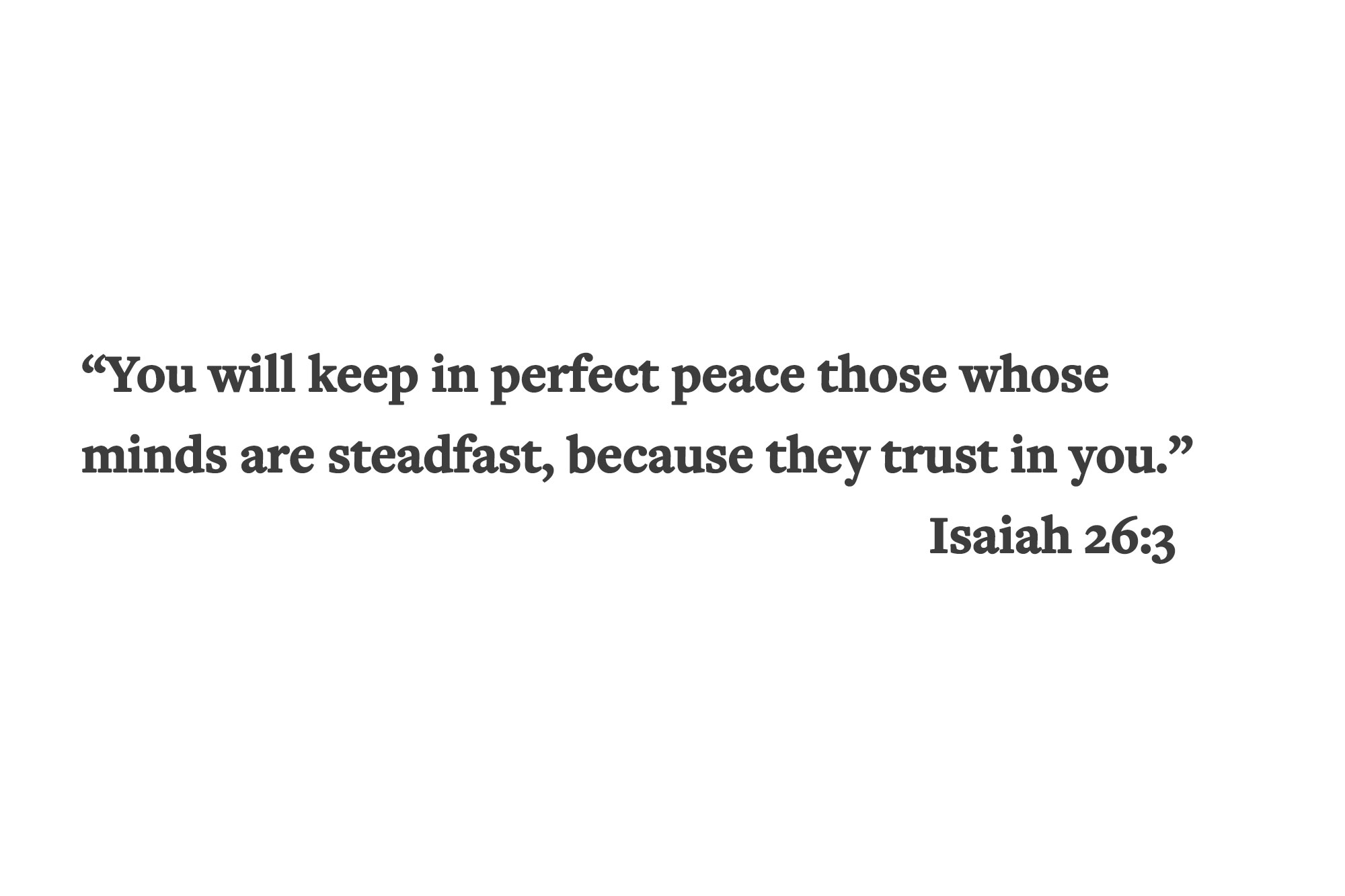
“You will keep in perfect peace those whose minds are steadfast, because they trust in you.” Isaiah 26:3

Life is all about changes and seasons, we all know this. However, we’ve placed these qualifiers on the verse as we navigate these changes and seasons. And it’s not necessarily our fault. Guarding my peace is the new catchphrase of pop psychology and relational or life coaches. They’ve taught us: “I got to guard my peace.” People like me, professionals, and paraprofessionals spend hours of your time and thousands of your dollars showing you how to build boundaries to keep or protect your peace. I saw a TikTok of a woman saying because she was doing such a good job protecting her peace, her only friend was her mother. I don’t think anyone is ill-intended when they give advice about boundaries and guarding your peace. It sounds really good.

However, we try very hard to protect perfect peace, not just peace. There are things in this world that give us peace – people, personal history, and the obvious one is money. Even our identity promises peace; if I know who I am, then no one can take that away. What happens to my identity when I change? Life circumstances we want, such as marriage, children, and careers, and ones we don’t want, such as loss, illness, and divorce, all challenge our sense of self. Any have the potential to give us peace, but also keep us out of perfect peace.

Does that mean that perfect peace is out of reach? No. The responsibility of keeping in perfect peace is not ours. It is God’s. When we try to create our own peace, we will fail every time. We need to begin to trust God.

Words are powerful. We know this to be true, but have tried to condition ourselves to not believe it. I don’t know if kids still say this, but when I was a kid we said, “Sticks and stones will break my bones, but words will never hurt me.” But the Bible says a gentle answer turns away wrath, demonstrating the power of words. The centurion said to Jesus, “I am a man of power and know that if I send a word, it will happen.” Words have power. The Scriptures remind us that the rudder, our tongue, guides the boat, and that the power of life and death are in the tongue. Jesus, awakened from His sleep during a violent storm, uses words to rebuke and calm the storm. When there is chaos, the very thing challenging our peace, we have to speak to the storm as Jesus did, using different words. We say, “I Trust Him.”

Many do not look at trust as a form of worship. But trust is worship. Worship is acts of devotion. When we trust someone, we place our faith in them; we sing their praises to others; we defend them when people try to attack them; we share their characteristics and stories with others. Trust is worship. Trust Him.

About the Author,
Yvonne Glass, Ph.D., LPCC-S

Executive Dean and Associate Professor of Counseling, Ashland Theological Seminary
gradient line
Yvonne Glass

Dr. Yvonne Glass brings over twenty years of clinical experience in various settings, including working within a school system, private practice and professional advocacy. Her studies included facilitating the incorporation of faith into the counseling experience and examined how religiosity positively impacts the daily stressors of life. Through various workshops for clergy, laypersons, paraprofessionals and professionals, she has been a voice for the practice of effective, clinical, mental health counseling. In addition to her clinical experience, she has worked within the Christian community through pastoral experience as an ordained Elder in the church, a leader in denominational organizations and service in various roles within the local church. In her current role, she oversees both counseling and theological faculty. Creating pipelines for theological education to equip modern day disciples encompasses much of her not only her work, but her passions. Through emphasizing the whole person, her work in theological education embodies her desire to build leaders for the Church. Dr. Glass holds her bachelor’s degree in biology, a master’s degree in Community Counseling and a doctorate in Counselor Education and Supervision from Kent State University.

More Articles