Revelation has been widely and closely studied as John’s answer to Roman imperial ideology – what we might call the political propaganda of the first century – based on his convictions about God’s character and rule and about the failure of Roman imperial rule to align with God’s character and rule. Immersion in the texts, images, religious practices, and other first-century media reveals the widespread dissemination of what can rightly be called “the gospel of Augustus and Roman rule.” Such a politico-religious myth provided the all-important ideological legitimation of Roman rule, rendering it an expression of the benevolent provision of the gods for the peaceful and prosperous ordering of human life, world without end, Amen. To the extent that the population of the provinces embraced this mythology, those dominated would consent to continue to be dominated.
It was therefore important for John to break any lingering spell – the “sorcery” – that this ubiquitous propaganda cast over Christ-followers and to do so in such a way as enabled steadfast resistance to what would prove, for several centuries at least, an undefeatable enemy of the Christian church and, thus, the “kingdom of our Lord and of his Anointed” (Rev. 11:15). Presenting his cure for the power of Roman imperial ideology in the form of an apocalypse or a prophetic communique – a word from the realm of God and the glorified Christ that John only mediated rather than as a sermon, tract, or typical letter (though Revelation is also a letter; Rev. 1:4) – allowed John to “re-mythologize” Rome and its imperial heads of state on the basis of the divine perspective of these entities revealed to him by the divine source. John presents this counter-ideology as a revelation – an “unveiling” – bestowed upon his audiences at God’s own initiative, with God’s own authorization (Rev. 1:1; 22:6). Only with such force behind it, it would seem, could John be sure that his content would jolt all of the Christ-followers out of the stupor of the worldwide deception of Roman political propaganda, a spell he claimed to have been cast over the Mediterranean by Satan himself (Rev. 12:9; cf. 13:14; 18:23; 19:20).
John locates the origin of the Roman imperial system in the rebellious activity of the dragon, a facet of the dragon’s reaction to his defeat in the heavenly sphere and failure to thwart the accession of God’s Anointed to the heavenly throne. Scholars rightly look to the idolatrous phenomenon of imperial cult – the acclamation and ongoing worship of select emperors and family members as gods – as a major impetus for John’s opposition (Rev. 13:4, 8, 11-15). John selected this egregious violation of the first commandment as an obvious point at which Christian counter-witness must coalesce (14:6-7, 9-11; 15:1-2; 20:4-5). But John was intent on exposing other facets of Roman imperialism that called down God’s inevitable judgment. Rome’s use of military force to unite and maintain its empire (felt with particular grief in Judea!), its parasitic economy siphoning off the wealth and resources of the provinces for its own conspicuous consumption, its self-aggrandizing ideology supporting a vision for “empire without limit” in terms of space and time, and its violent silencing of dissenting voices – most notably, for John, those who witnessed to the one true God and the one true kingdom without end – all cried out for justice (Rev. 6:9-11; 13:7; 16:5-7; 17:1-6; 18:3, 6-8, 11-17, 23-24; 19:1-2). Whether one locates Revelation in 68-69 or in the early 90’s, the memory of Nero’s brutal and farcically innovative executions of Christians in Rome would have left a lasting impression on John’s mind – and revealed the emperor to be just another tyrant, cruelty being a standard accessory in the tyrant’s wardrobe. Rome’s willingness to grant a small share in its pleasures and prosperity (what John would call its “fornication” or “seduction”) could not be allowed to stifle witness to its crimes or seduce God’s ransomed ones into silence or, worse, partnership (Rev. 18:4).
Once again it is important to take stock of the distance at which any modern nation stands from the target of John’s exposé. Christians in nations like North Korea face uncannily similar dynamics and endure coercive measures as severe as anything John foresaw. The situation in the United States is vastly different, of course, made even more complex by the once-popular ideology of being a distinctively “Christian nation” – an ideology that has made a comeback. Christ-followers have the political, economic, and social right to live lives that reflect and bear witness to Christ’s lordship. A major challenge in the present political climate, however, is to do so while maintaining critical distance from those very structures that we think we can manipulate to Christ’s advantage, lest we find ourselves in bed once again with the domination systems of the world, their contaminating ideology, their idolatrous claims on our allegiance. Howard-Brook and Gwyther perceptively remark that, in the First World context, “seduction, rather than the fear of persecution,” presents the greater danger to Christ-followers.
Many Christians in America have made common cause with Donald Trump and his particular brand of Republicanism because they regarded this as a means by which to channel the power of the State to enact what they perceived to be a “Christian” agenda for American society. In the process, many lauded Trump as a “new Cyrus,” a figure that God would use to set this nation right in important ways. Scenes of prominent Christian pastor-celebrities gathered around Trump, laying their hands on him in prayer, Trump holding up a Bible in front of a church, and AI-engineered portraits of Jesus standing behind a Trump on his knees, hands on Trump’s soldiers, gave him religious legitimation as a divinely-summoned political candidate and president using the language, practices, and images of Christianity. Where John wrote in a context in which provincial elites led their neighbors to regard the Roman state and its rulers to be divine, in our context politico-religious elites have led vast numbers of their political party to declare a political figure and his movement to be instruments of the divine. It is a strikingly similar dynamic, merely tailored to Christian monotheism. Either way, “the religious or, if you will, the theological justification which the first beast absolutely cannot do without” is being freely and generously applied.
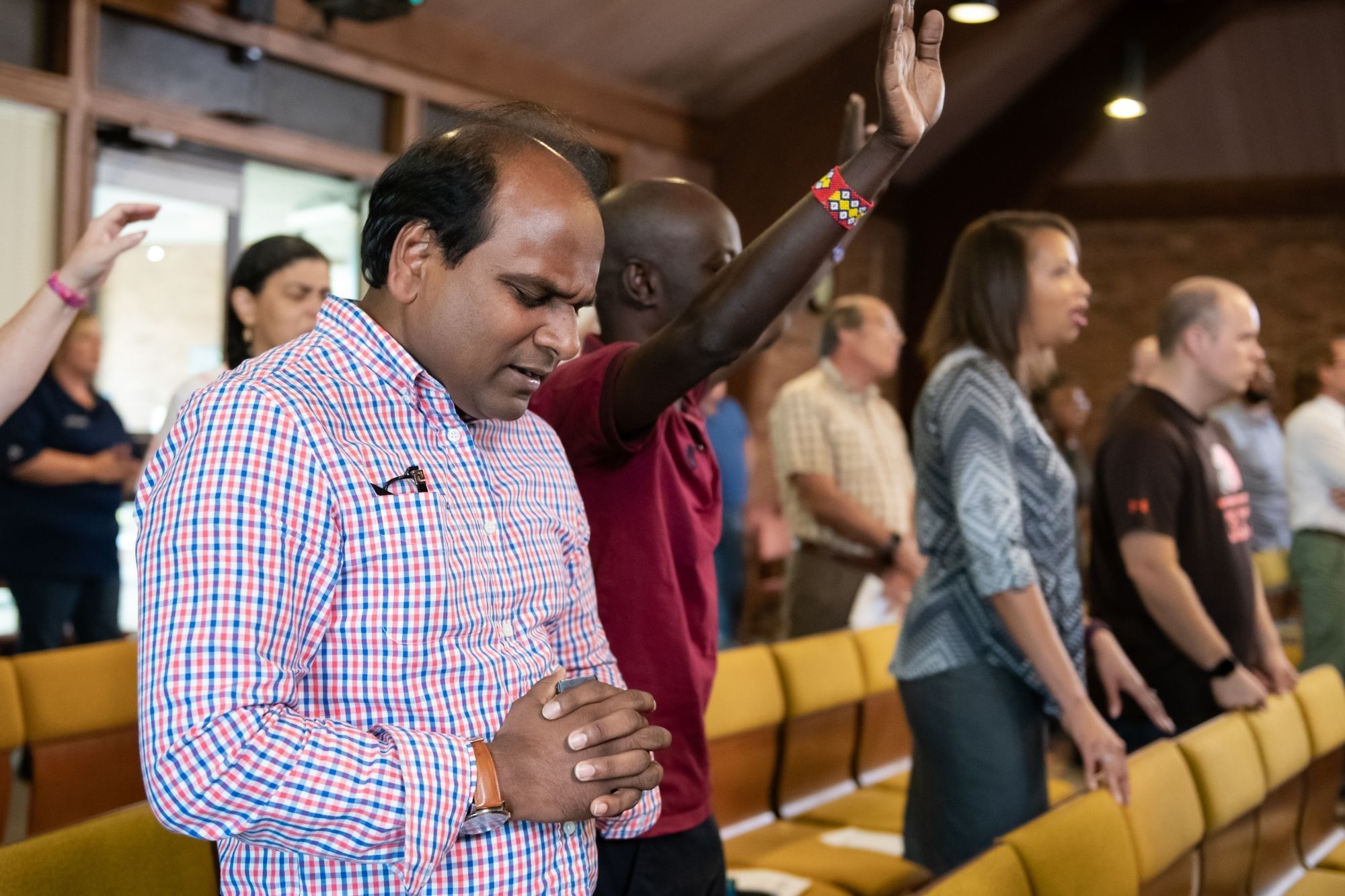
John’s reaction to the use of religious language and forms to legitimate Roman power should give Christ-followers pause. John would caution Christians against the dangers of lending religious legitimation to political parties, personalities, and agendas without maintaining the distance that allows for both affirmation and critique, that continues to remind politicians of their accountability to God and God’s vision for the holy and just use of power, both in terms of the means and the ends. Revelation also problematizes the absolute loyalty that the MAGA movement demands and that its members, including many who identify themselves as Christians, appear to enforce against any who voice criticism of the regime. This is, rather, the loyalty that all Christians owe only to one regime – the kingdom of God and his Anointed, which will one day supplant the American state and any of its successors in the ongoing flow of history.
John’s inconvenient insistence on dragging “Babylon’s” crimes into the light of day seems to be reflected in the increased attention given to America’s national “sins” throughout the first part of the 21st century. John’s vision of God’s murdered witnesses crying out from beneath the heavenly temple’s altar for vindication (Rev. 6:9-11) resonates with modern prophets naming America’s acts of injustice that are still crying out for vindication – or, at least, recognition and admission. One can well understand why (privileged) Americans, as beneficiaries of the state, would react negatively to shining spotlights into the darker corners of our history and ongoing practice, preferring to educate the next generation in the expurgated “myth” of American history. It is more difficult to understand why Christians in America would not be unified in uncovering, owning, and leading the way in repentance for the immoral, unjust, and oppressive means that the United States and its agents have employed while advancing the interests of this nation or its people. In Christian practice, naming and repenting of sin always leads towards rehabilitation in God’s sight. It is never something to avoid or minimize. Awareness of groups whose souls cry out to God for justice against our own nation helps us avoid being taken in by the propaganda of the day concerning the nation, its destiny, its enjoyment of divine favor and to see it more clearly in the light of the God who, John assures us, hears the cries of those who have suffered injustice. That we are not so united indicates the amnesty some Christians are willing to give to the political powers in exchange for the benefits they receive. John would caution against this as political prostitution.
John’s demonstration of the superior power of God and God’s Anointed vis-à-vis the “Beast” and “Babylon” in his narration of the fate of these figures serves important goals for his audiences. Firmly believing oneself ultimately to be on the winning side facilitated accepting the costs of openly identifying with that side in the here and now of first-century Roman Asia. It emboldened believers to witness to these authorities, to call them out where they departed from the practices God affirmed as just, holy, and good, and ultimately to declare their absolute allegiance to God’s Anointed “ruler of the kings of the earth” (Rev. 1:5).
Walter Wink has perceptively observed that “the Dragon’s strategy is to eviscerate opposition by a sense of induced powerlessness… ‘Who is like the Beast, and who can fight against it?’ (Rev. 13:3-4).” Howard-Brook and Gwyther go further and call this a “form of idol worship, if only in the negative sense of giving up hope that there is a force greater than empire to which people can turn in trust when empire seems overwhelming.” Revelation both unmasked oppressors and repaired the will of their victims. Allan Boesak demonstrated its power to continue to do so in apartheid South Africa, where affirming of the apartheid state that “it goes to perdition” (Rev. 17:11) was essential to continued resistance in the face of horrendous penalties. Where the state reassured itself and its security with every tightening of its grip, every abuse of power, every victim unjustly disappeared or killed, the discerning citizens of God’s kingdom saw the signs that “it goes to perdition.” Christians in free democratic societies may also need to hear this word, as many have voiced despair in the face, for example, of the intransigent polarization over politics in the United States. No temporal power can ultimately stand in the way of the kingdom of God. This hope, this faith, is itself an act of resistance. And it can sustain witness even when it feels like whispering into a maelstrom.
The material in this post will appear in modified form later this year in David A. deSilva, Living in an Unholy Empire: Revelation’s Call to a Higher Allegiance (Hendrickson Publishing, 2026).